

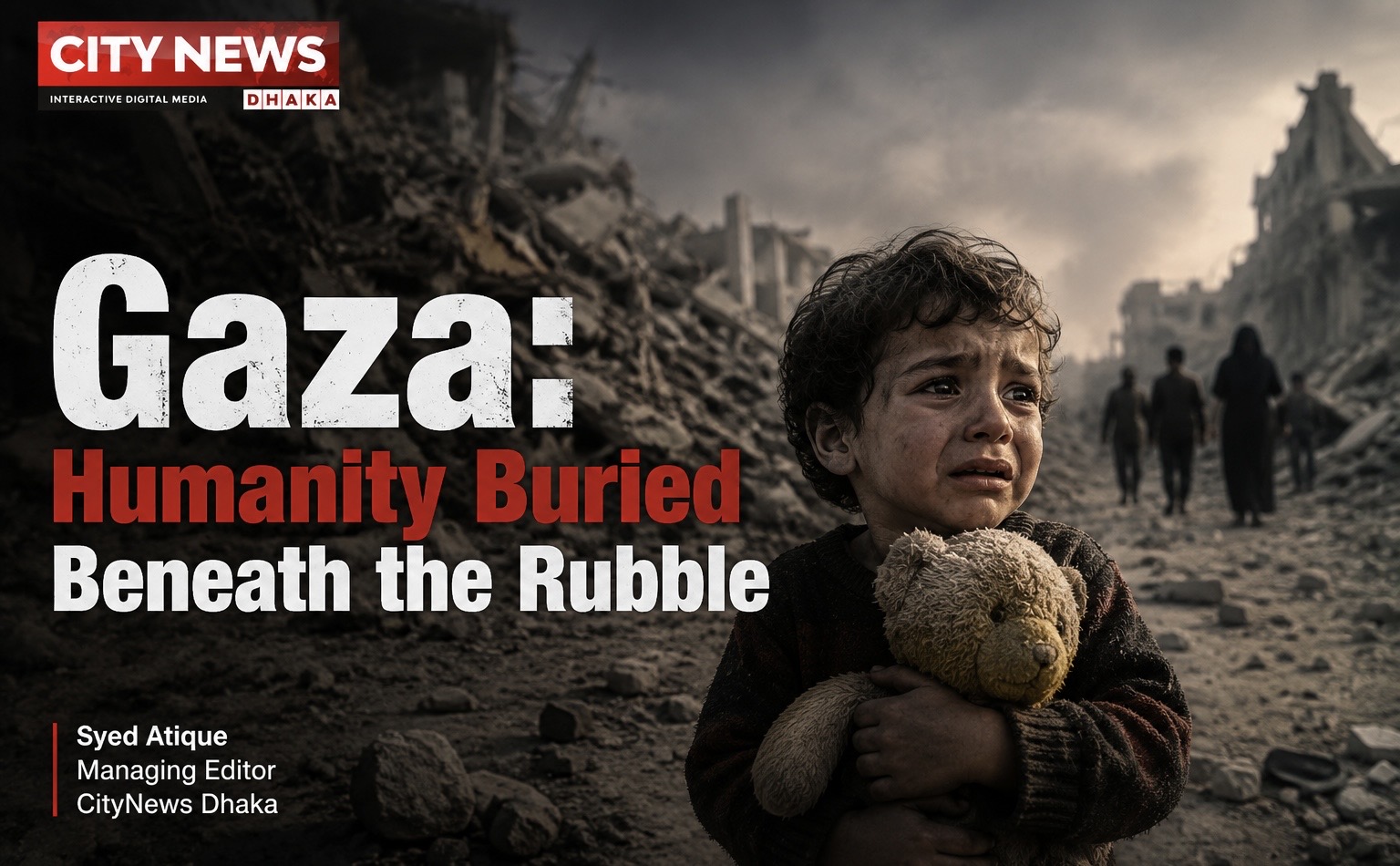
Although summer has begun in war-ravaged Gaza, nearly one million people continue to live in tents and temporary shelters under inhumane conditions. According to the Norwegian Refugee Council (NRC), the worsening shelter crisis, severe shortages of humanitarian aid, and the prolonged conflict have pushed the humanitarian situation to even more alarming levels.
The NRC reports that around 170,000 families are currently living in tents, approximately 5,000 families are forced to sleep in the open air, and another 52,000 families are crowded into overcrowded collective shelters. As scorching summer temperatures intensify, the suffering of these displaced people has reached a new level.
History remembers many places whose names evoke images of war, death, and human suffering. In the 21st century, Gaza has become one of the most prominent among them. This small strip of land along the Mediterranean coast is no longer merely a geopolitical flashpoint—it has become a symbol of humanitarian catastrophe, displacement, hunger, uncertainty, and the relentless struggle to survive.
Looking at Gaza today forces the world to confront a difficult question: Has humanity truly progressed, or have we simply advanced technologically while losing our sense of compassion?
The streets where children once laughed, bustling markets where families shopped, and beaches where people gathered have largely been reduced to rubble. Countless families have lost homes that carried generations of memories. Houses that once represented safety have become piles of broken concrete and shattered dreams.
Losing a home is not merely losing a building. It means losing one’s identity, memories, and roots. Millions of Gazans carry that pain every single day.
Across Gaza, countless people now live in makeshift tents. Under the relentless summer sun, these plastic and fabric shelters often become unbearably hot, resembling ovens. It is difficult to imagine the suffering of children trapped inside them. Many mothers shield their children with their own bodies, trying to provide a little shade. Yet a mother’s love cannot stop the heat, eliminate hunger, or guarantee safety.
Gaza’s tragedy cannot be understood through statistics alone. Behind every number lies a family, a life, and a dream. When thousands are reported dead, it means thousands of unfinished stories. When millions are described as displaced, it means millions of people who do not know where they will sleep tomorrow.
Perhaps the most heartbreaking reality is the plight of Gaza’s children. No child should spend their childhood surrounded by explosions, destruction, and fear. Yet for many children in Gaza, war has become normal. They have never experienced uninterrupted peace. They do not know what it feels like to attend school without fear or to sleep through the night without the sound of bombs.
When a child draws tanks, smoke, and destroyed buildings instead of homes and playgrounds, it becomes painfully clear that war destroys not only buildings—it destroys the future itself.
The healthcare system has also been pushed to the brink. Hospitals continue operating with extremely limited resources. Doctors and healthcare workers perform extraordinary acts of courage every day despite shortages of medicines, equipment, and overwhelming numbers of casualties. But when the number of wounded far exceeds medical capacity, the humanitarian crisis deepens.
Food and clean water remain critically scarce. Limited access to safe drinking water, insufficient food supplies, and inadequate healthcare have made daily survival increasingly difficult. When a father cannot provide even a single meal for his child, his helplessness reflects not only a personal tragedy but also a failure of humanity as a whole.
Women in Gaza bear another silent burden. They struggle to keep their children alive, secure food, and hold their families together inside temporary shelters. Yet they continue to hold onto hope, because without hope, survival itself loses meaning.
Gaza reminds us that the true cost of war can never be measured solely through military strategies or political calculations. The greatest price is always paid by ordinary civilians—people who never carried weapons, never made political decisions, and simply wished to live peaceful lives.
Around diplomatic tables, Gaza may be discussed as a political issue or a security concern. In reality, however, Gaza is about human lives, human tears, and human dreams. Every morning begins with uncertainty, and every night ends with prayers for survival.
Today, the world’s greatest challenge is not merely ending the fighting—it is preserving our shared humanity. If the cries of a child, the grief of a mother, or the destruction of an entire family no longer shake our conscience, then all of civilization’s achievements lose their meaning.
Gaza has become a mirror reflecting our time. In that mirror, we see not only a devastated territory but also the limitations of humanity, the weaknesses of the international system, and the world’s commitment to peace being put to the ultimate test.
Even beneath the rubble, the people of Gaza continue to dream of survival. That dream belongs not only to them but also to all of humanity. The question remains: Will we help keep that dream alive, or will we stand by as silent witnesses to yet another tragic chapter in history?
Statistics alone cannot fully explain Gaza’s crisis, yet they reveal the devastating scale of the tragedy. Since October 2023 through June 2026, more than 73,000 people have reportedly been killed, while over 173,000 have been injured. More than 20,000 of those killed were children who never had the chance to grow up.
Approximately 90 percent of Gaza’s population has been displaced at least once, meaning around 1.8 to 1.9 million people have been forced to leave their homes and seek refuge in shelters, tents, or temporary camps. Entire residential neighborhoods have been destroyed, leaving countless families uncertain if they will ever return home.
The food crisis has become equally severe. Around 1.6 million people face acute food insecurity, including more than 800,000 children. Many families survive without sufficient food for days at a time. Meanwhile, over 70 percent of Gaza’s population now depends on trucked water due to the collapse of safe water infrastructure.
The healthcare system has effectively collapsed. Most hospitals and medical facilities have either been damaged or continue operating with only limited capacity. Humanitarian organizations report that virtually no fully functioning hospitals remain, forcing exhausted medical workers to fight for lives with inadequate supplies.
Children continue to suffer the most. Early estimates indicated that at least 19,000 children had lost one or both parents. Beyond those devastating losses, nearly every child in Gaza now carries deep psychological trauma caused by war, death, displacement, and constant fear. Their childhood has been buried beneath the rubble.
These figures are not merely statistics. Behind every one of the 73,000 deaths lies an unfinished story. Behind every one of the more than 20,000 children killed lies a future that will never be realized. And in the eyes of millions of displaced people remains a single question: When will peace return? When will they finally have a home again?
The NRC emphasizes that Gaza’s crisis is driven by far more than extreme weather. Prolonged conflict, widespread destruction, repeated forced displacement, and persistent obstacles to delivering humanitarian assistance have all compounded the emergency.
The organization warns that summer temperatures may reach 34.5°C (94.1°F), significantly increasing health risks and hardship for those living in tents and temporary shelters.
After nearly 987 days of conflict, millions remain without permanent housing. Humanitarian agencies warn that unless emergency shelter assistance and reconstruction efforts are rapidly expanded, Gaza’s humanitarian catastrophe is likely to worsen even further. [email protected]











Comment :