

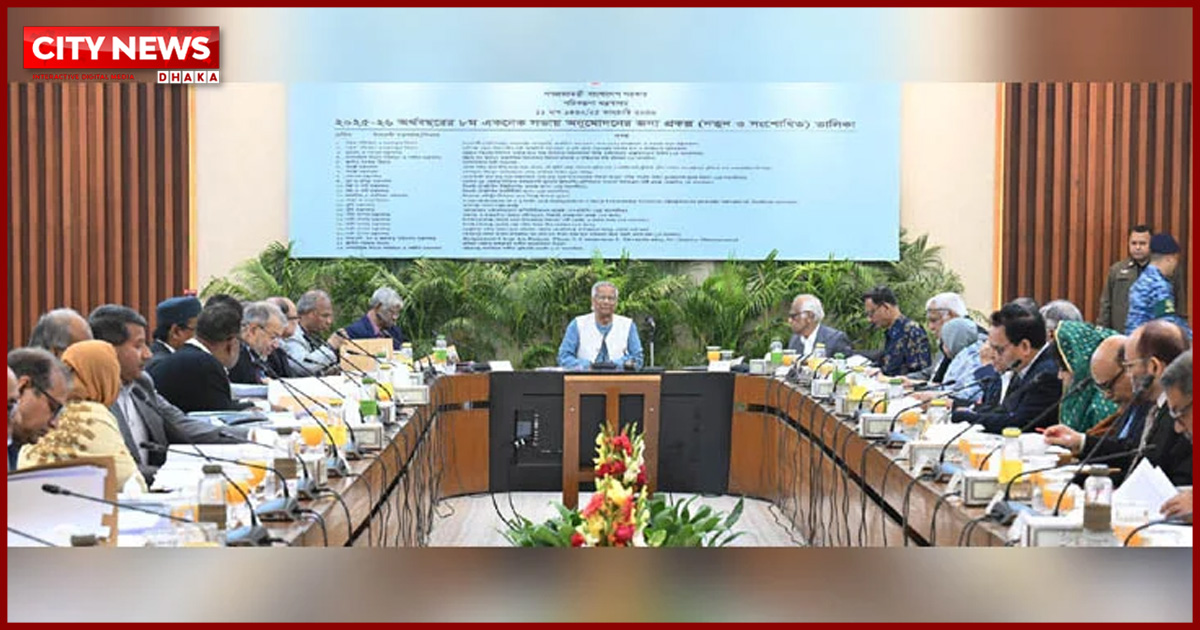
The government today approved a major healthcare infrastructure project worth Taka 2,459.34 crore to establish a 1,000-bed Bangladesh-China Friendship General Hospital in Nilphamari.
The project was approved by the Executive Committee of the National Executive Committee (ECNEC) aimed at ensuring modern and specialised medical services for people in the northern region of the country and thus easing pressure on hospitals in Dhaka and Rangpur.
The project, titled "Establishment of a 1,000-bed Bangladesh-China Friendship General Hospital", has an estimated cost of Taka 2,459.34 crore.
Of the total amount, Taka 179.27 crore will come from the government`s own resources, while Taka 2,280.07 crore will be financed through external sources, primarily with financial and technical assistance from the Chinese government.
The project will be implemented from January 2026 to December 2029 in Nilphamari sadar upazila under Rangpur division.
Talking to BSS, Planning Commission officials said the objective of the project is to establish a modern, specialised 1,000-bed general hospital to ensure quality healthcare for the people of northern Bangladesh.
The hospital will provide integrated general and specialised services, including nephrology, cardiology, oncology and neurology, enabling effective treatment of complex and long-term diseases.
Briefing reporters after the day`s ECNEC meeting, Planning Adviser Dr Wahiduddin Mahmud said the Bangladesh-China Friendship Hospital in Nilphamari is a strategic and timely initiative.
He said the proposal emerged from discussions at the highest level during the Chief Adviser`s visit to China, where the Chinese side expressed interest in
supporting the construction of a highly modern hospital in Bangladesh.
Dr Mahmud clarified that the decision to establish the hospital in Nilphamari was taken by Bangladesh, not China, as part of a broader plan to gradually decentralise major national facilities from Dhaka.
"If we want real decentralisation, large and advanced institutions-whether universities, hospitals or technology institutes-must be established outside
Dhaka," he added.
He noted that Nilphamari`s location in the Rangpur region, traditionally affected by poverty and seasonal hardship, made it a strategic choice.
The presence of Syedpur Airport nearby is also expected to enhance accessibility. Given the planned standard of the hospital, he expressed hope that patients from neighbouring countries may also seek treatment there, as no similar facility of this level exists in the surrounding region.
Dr Mahmud added that while the project has been approved to facilitate the signing of a formal agreement with China, the final cost structure may be adjusted once the exact amount and nature of Chinese assistance are finalised.
The project also aims to reduce excessive patient pressure on hospitals in Rangpur and Dhaka through decentralisation of healthcare services, while ensuring timely and life-saving treatment through modern emergency facilities, ICU, CCU and HDU units, advanced diagnostic services and state-of-the-art operation theatres.
In addition, the hospital will contribute to medical research, training and human resource development, strengthening the overall capacity of the country`s health sector.
Modern technology, hospital automation, electronic health records (EHR) and digital health systems will be introduced to improve efficiency and patient care.
The initiative is also expected to reduce patients` treatment costs and travel-related hardship by ensuring equitable access to advanced healthcare services closer to home.
The main components of the project include a 10-storey main hospital building with a semi-basement covering approximately 993,691 square feet; a 10-storey professors` and senior doctors` quarters with semi-basement (96,800 square feet); a 10-storey doctors` dormitory with studio apartments (65,000 square
feet); a two-storey duplex building for directors; two six-storey nurses` dormitory buildings; two 10-storey residential buildings for second-and third-class employees; a two-storey mosque; a one-storey hospital kitchen; a waste management plant; a five-storey service building; a hospital gas manifold and VacuumInsulated Evaporator (VIE) tank facility; a helipad and automated ambulance system; and a two-storey generator and substation building.
Explaining the background of the project, officials said Nilphamari district has a population of around 2.1 million, most of whom live in rural and semi-urban areas.
Currently, healthcare services in the district mainly depend on the 250-bed Nilphamari General Hospital and primary healthcare facilities at the upazila level.
These facilities lack sufficient ICU, HDU, dialysis services, comprehensive cancer units, neuro-emergency care, cardiac care, burn and plastic surgery services, as well as specialised maternal and neonatal care.
As a result, critically ill patients are frequently referred to Rangpur Medical College and Hospital or Dhaka Medical College and Hospital, causing delays, higher costs and increased risks.
Officials believe the hospital will emerge as a sustainable tertiary-level healthcare institution, significantly reducing regional disparities in healthcare access and ensuring timely, quality and life-saving medical services for millions of people in northern Bangladesh.









Comment :