

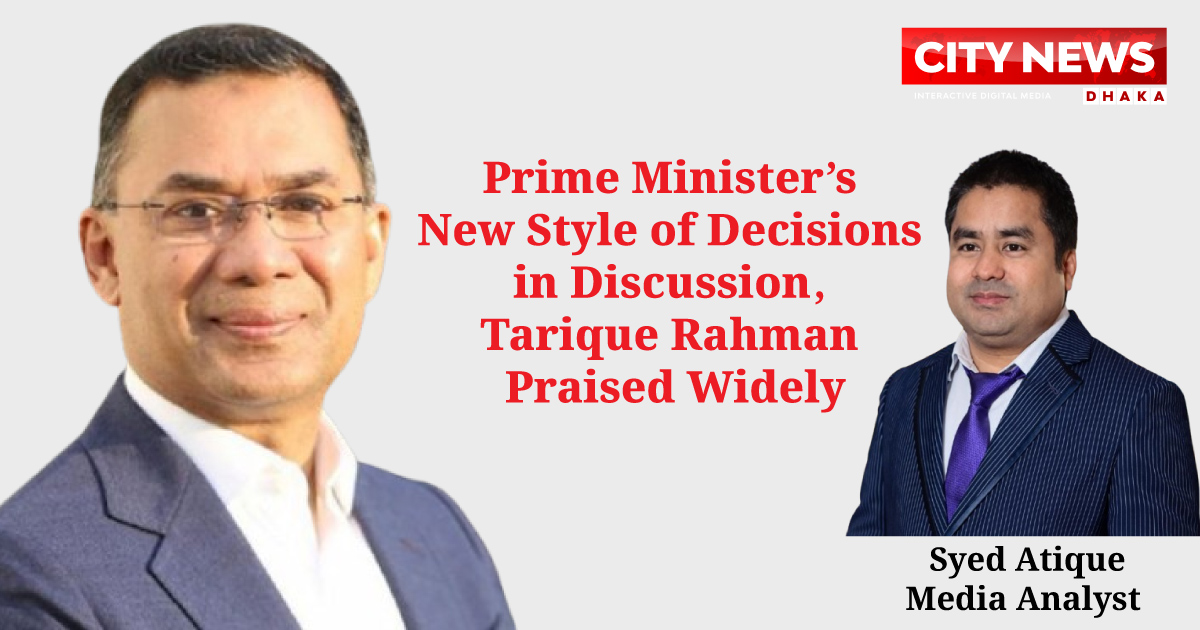
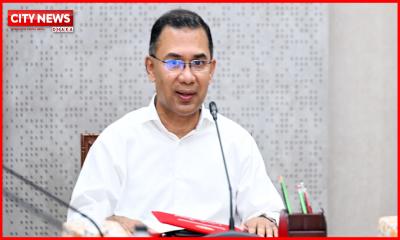
In recent weeks, Bangladesh’s political landscape has witnessed a new wave of discussion surrounding Prime Minister Tarique Rahman. Since assuming office following a decisive electoral victory, Rahman has introduced a series of policy signals and administrative decisions that have attracted both public attention and political debate.
Observers say these moves indicate an attempt to redefine the tone of governance—emphasizing administrative accountability, cost efficiency, and a more people-centric political style.
The 180-Day Performance Window
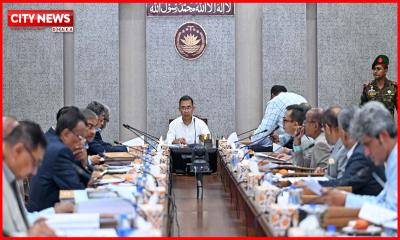
One of the most notable initiatives introduced by the Prime Minister is a 180-day action framework for government ministers. Under this plan, each ministry has been asked to define specific programs and measurable outcomes within a six-month period.
Political analysts describe this period as a “performance window.” During this timeframe, ministers’ efficiency, policy execution, discipline, and public engagement are expected to be evaluated closely.
The implications are significant. After the 180-day period, the government may consider cabinet reshuffles, redistribution of responsibilities, or other administrative changes depending on the outcomes.
Already, the initiative appears to be shaping political behavior. Ministers are reportedly becoming more cautious in public statements and more active in field-level governance. Many believe an informal internal evaluation system—often described as a political “good book” and “bad book”—is emerging, where ministers’ performance and public perception are quietly being recorded.
Policy Priorities: Economy, Security, and Essential Services
The government’s 180-day agenda identifies three immediate priorities:
• Stabilizing essential commodity prices
• Strengthening law and order
• Ensuring uninterrupted gas, electricity, and other essential services
These priorities reflect some of the most pressing concerns facing Bangladesh’s citizens. By placing them at the center of the early governance agenda, the administration appears to be signaling a focus on practical, short-term deliverables.
Symbolic Leadership and Administrative Simplicity
Beyond policy directives, several symbolic actions by Prime Minister Rahman have also generated discussion.
Reports indicate that upon arriving at the Secretariat, he encouraged measures to reduce electricity consumption, including limiting unnecessary lighting and air-conditioning. He also made headlines by walking from the Secretariat to the Osmani Memorial Auditorium rather than relying on traditional VIP motorcades.
Other initiatives—such as reducing government vehicle convoys, discouraging long road closures for VIP movement, and emphasizing institutional decision-making over personality-driven governance—have reinforced the image of a leadership style focused on simplicity and efficiency.
For many citizens, these gestures carry symbolic value. They suggest an attempt to narrow the perceived distance between political leadership and ordinary people.
From Political Leader to Statesman?
Tarique Rahman’s rise within the Bangladesh Nationalist Party has been gradual. Beginning his political journey within the party’s organizational structure, he worked through various leadership roles before eventually assuming the position of chairman.
Analysts note that decades of political experience, organizational leadership, and involvement in party strategy have shaped his political persona. Now, as Prime Minister, some observers argue that Rahman is entering a new phase—one in which he must transition from a party leader to a national statesman.
Whether this transition ultimately succeeds will depend less on symbolism and more on policy outcomes and long-term governance performance.
Shorter Protocol for Foreign Visits
Another decision drawing attention is the Prime Minister’s move to simplify airport protocol during foreign visits.
Traditionally, a large group of ministers, advisers, senior officials, and military chiefs would gather at airports during the Prime Minister’s departure or arrival. Under the new directive, that list has been reduced to just four officials.
Supporters view the move as a message of administrative efficiency and cost reduction. Critics, however, argue that such symbolic gestures must eventually be matched with deeper institutional reforms.
The Road Ahead
For now, Prime Minister Tarique Rahman remains one of the most widely discussed figures in Bangladesh’s political arena. His early decisions have sparked debate about whether the country may be witnessing the emergence of a different governance style—one that blends symbolic leadership with administrative restructuring.
Yet, as political observers frequently note, the true measure of leadership lies not in early gestures but in long-term outcomes. The coming months—and the results of the government’s 180-day performance window—will likely determine how this chapter in Bangladesh’s political story unfolds.
Syed Atique
Media Analyst







Comment :