

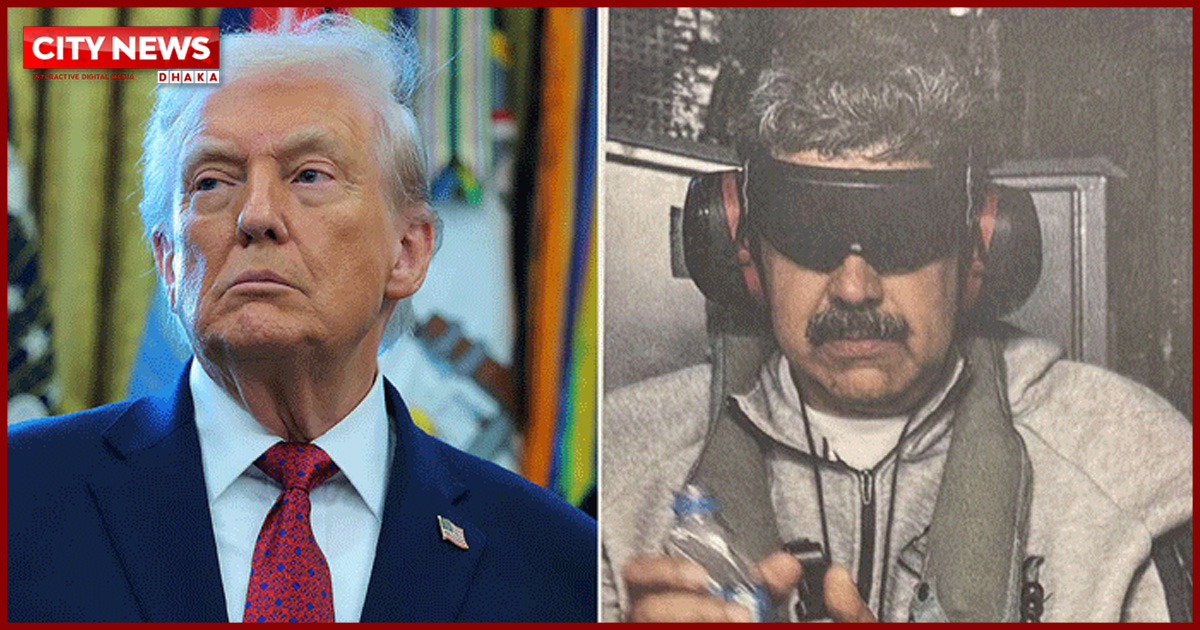
President Donald Trump’s decision to attack Venezuela, arrest its president and temporarily run the country marks a striking departure for a politician who long criticized others for overreaching on foreign affairs and vowed to avoid foreign entanglements.
His vision for U.S. involvement in Venezuela, sketched out in a midday news conference, left open the possibility of more military action, ongoing involvement in that nation’s politics and oil industry and even “boots on the ground.” The term suggests military deployment of the sort that presidents often avoid for fear of provoking domestic political backlash.
"We`re going to run the country until such time as we can do a safe, proper and judicious transition," Trump said during a press conference at his Mar-a-Lago resort in Florida. "We can`t take a chance that someone else takes over Venezuela who doesn`t have the interests of Venezuelans in mind."
It is unclear how Trump plans to oversee Venezuela. Despite a dramatic overnight operation that knocked out electricity in part of Caracas and captured President Nicolas Maduro in or near one of his safe houses, U.S. forces have no control over the country itself, and Maduro`s government appears to still be in charge.
Trump`s comments about an open-ended presence in Venezuela echoed past leadership changes in Iraq and Afghanistan, both of which ended in U.S. withdrawals after years of occupation. He said he was open to the idea of sending U.S. forces into Venezuela.
"We`re not afraid of boots on the ground," he said.
Trump did not provide specific answers to repeated questions from reporters about how the U.S. would run Venezuela.
U.S. TO BE REIMBURSED: TRUMP
A U.S. occupation "won`t cost us a penny" because the United States would be reimbursed from the "money coming out of the ground," Trump said, referring to Venezuela`s oil reserves, a subject he returned to repeatedly during Saturday`s press conference.
Trump said U.S. Secretary of State Marco Rubio had been in touch with Venezuelan Vice President Delcy Rodriguez — Maduro’s presumptive successor.
"`We`ll do whatever you need,`" Trump quoted Rodriguez as saying. "She really doesn`t have a choice."
Four sources familiar with her movements said Rodriguez was in Russia. The Russian foreign ministry dismissed the report about Rodriguez`s presence in their country as "fake."
POTENTIAL POWER VACUUM
The removal of Maduro, who led Venezuela with a heavy hand for more than 12 years, potentially opens a power vacuum in the Latin American country.
Any serious destabilization in the nation of 28 million people threatens to hand Trump the type of quagmire that has marked U.S. foreign policy for much of the 21st century, like the interventions in Afghanistan and Iraq.
The U.S. has not made such a direct intervention in its backyard region since the invasion of Panama 37 years ago to depose military leader Manuel Noriega over allegations that he led a drug-running operation. The United States has leveled similar charges against Maduro, accusing him of running a "narco-state" and rigging the 2024 election.
Maduro, a 63-year-old former bus driver handpicked by the dying Hugo Chavez to succeed him in 2013, has denied those claims and said Washington was intent on taking control of his nation`s oil reserves, the largest in the world.
As recently as his inauguration for a second term last January, Trump told supporters: "We will measure our success not only by the battles we win, but also by the wars that we end, and perhaps most importantly, by the wars we never get into."
Since then, Trump has bombed targets in Syria, Iraq, Iran, Nigeria, Yemen and Somalia, blown up dozens of alleged drug boats in the Caribbean Sea and Pacific Ocean and made veiled threats to invade Greenland and Panama.
The overnight attack on Venezuela was his most aggressive foreign military action yet, striking the capital Caracas and other parts of the country and capturing Maduro and his wife to face drug-trafficking charges in New York.
These developments ran counter to some Republican hopes that the president would focus more on voters` main domestic concerns – affordability, health care and the economy.
Trump told reporters in his news conference that intervening in Venezuela was in line with his “America First” policy.
“We want to surround ourselves with good neighbors. We want to surround ourself with stability. We want to surround ourself with energy,” he said, referring to Venezuela’s oil reserves.
But the emerging political stakes were captured by a social media post from U.S. Representative Marjorie Taylor Greene, a Georgia Republican, who has broken with Trump in recent months, because of what she said has been his departure from the America First rhetoric of his campaign and its promise of limiting foreign adventures. She is resigning from Congress next week.
“This is what many in MAGA thought they voted to end. Boy were we wrong.”
RISK OF QUAGMIRE
Trump’s ongoing attention to foreign affairs provides fuel for Democrats to criticize Trump ahead of midterm congressional elections in November, when control of both houses of Congress is likely to turn on just a few races across the United States. Republicans narrowly control both right now, giving the president a largely free hand to enact his agenda.
“How does going to war in South America help regular Americans who are struggling?" Senator Chris Murphy, a Democrat, wrote on X. “What is the actual security threat to the United States? And (what) happens next in Venezuela?"
Trump has worked to end several foreign conflicts, including in Ukraine and Gaza, while lobbying for a Nobel Peace Prize. But U.S. military actions tend to draw more public attention and historically have carried more political risk for presidents and their parties.
Polls have shown that, before the attack, the prospect of U.S. military action in Venezuela was unpopular, with roughly one out of five Americans supporting force to depose Maduro, according to a November Reuters/Ipsos survey.
REPUBLICAN DEBATE OVER FOREIGN POLICY
Trump’s top diplomat and national security adviser Marco Rubio called several members of Congress early on Saturday in an effort to blunt opposition to military action.
Mike Lee, a prominent libertarian-leaning senator, initially questioned the administration taking military action without a declaration of war or authorization for the use of military force, but wrote on X he concluded that the operation likely fell within the president`s authority after speaking to Rubio.
Republican Representative Thomas Massie, a frequent Trump critic, wrote in a post on X that Trump’s warning of further strikes on Venezuela “Doesn’t seem the least bit consistent” with Rubio’s characterization to Lee. “If this action were constitutionally sound, the Attorney General wouldn’t be tweeting that they’ve arrested the President of a sovereign country and his wife for possessing guns in violation of a 1934 U.S. firearm law,” Massie wrote in a separate post.
U.S. ‘WILL GET TANGLED UP’
For a president who has consistently contrasted himself with the Republican "neoconservatives" of the late 20th century, Trump’s foreign policy has developed striking similarities with that of his predecessors.
In 1983, under former President Ronald Reagan, the U.S. invaded Grenada, claiming that the government at that time was illegitimate, a claim Trump has also made with respect to Maduro.
In 1989, former President George H.W. Bush invaded Panama to depose dictator Manuel Noriega who, like Maduro, was wanted on U.S. drug-trafficking charges. In that case, the U.S. installed Noriega’s replacement.
Trump’s allies argue that actions in the western hemisphere differ from the War on Terror interventions that Trump has criticized. Trump’s National Security Strategy published last month promised a revival of the 19th century Monroe Doctrine that prioritizes U.S. dominance in Latin America.
The Trump administration at first justified its pressure campaign against Maduro as a drug enforcement operation, but would now be sucked into overseeing a complex transition in Venezuela, said Brett Bruen, a former foreign policy adviser in Barack Obama`s administration. Key regional players like Mexico and Brazil could be pushed closer to China and possibly Russia by the move.
“I don’t see any short version of this story,” said Bruen, now head of the Global Situation Room, a public relations consultancy. “The U.S. will get tangled up in Venezuela but will also have new problems to contend with related to its neighbors.”
Source: Japan Today
Comment :