

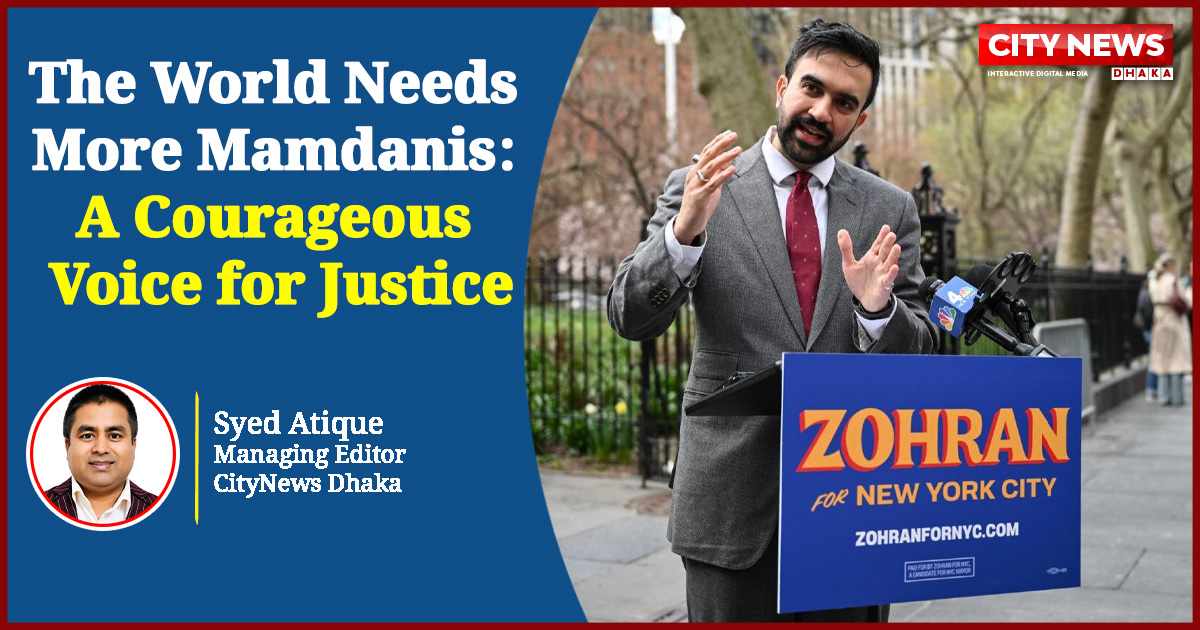
One of the greatest crises in global politics today is that international law is not applied equally. Leaders and military officials from weaker nations often face swift accountability, while those from powerful states are frequently shielded by political calculations, diplomatic hesitation, and strategic silence. This double standard has done more than anything else to undermine the credibility of the international justice system.
Against this backdrop, New York City Mayor Zohran Mamdani’s remarks have sparked debate far beyond the United States. By referring to the International Criminal Court’s (ICC) arrest warrant for Israeli Prime Minister Benjamin Netanyahu, Mamdani did more than make a political statement—he brought the issues of international law, accountability, and human dignity back into the global conversation. His assertion that Netanyahu belongs in The Hague rather than New York has undoubtedly generated controversy, but it also reflects a willingness to ask difficult questions that many politicians prefer to avoid.
The ongoing war in Gaza has resulted in the deaths of thousands of civilians, widespread destruction, severe humanitarian suffering, and repeated allegations concerning attacks on hospitals, schools, and refugee camps. At the same time, Hamas’s October 7 attack, which killed Israeli civilians and took hostages, has rightly been condemned by the international community. The legal determination of these allegations belongs to independent courts, but ignoring them—or allowing political interests to weaken judicial processes—amounts to a betrayal of the very principles international justice was created to uphold.
If international law is enforced only against the weak while the powerful remain beyond its reach, it ceases to function as law. Instead, it becomes an instrument of political power. Such selective justice erodes global confidence in institutions that were established to protect human rights and uphold accountability.
One of Mamdani’s greatest strengths is his moral consistency. He has condemned Hamas’s terrorist attacks while also criticizing the humanitarian consequences of Israel’s military campaign in Gaza. This balanced position distinguishes him from those who defend one side unconditionally. His message is simple: innocent lives carry equal value regardless of nationality, religion, or political affiliation.
It is true that the Mayor of New York City has no independent legal authority to arrest a foreign head of government, and the United States is not a party to the Rome Statute that established the ICC. Yet the significance of Mamdani’s remarks lies not in legal power, but in moral courage. He has raised a question that many influential leaders hesitate to ask openly: Is the rule of law truly universal, or is it reserved only for the powerless?
The legitimacy of the international legal order depends not only on treaties and institutions but also on the consistent application of justice. When similar allegations produce different responses depending on political influence, public trust in international institutions inevitably weakens. Equal justice cannot remain an aspiration; it must become a practice.
Today, the world needs more leaders like Zohran Mamdani—leaders who speak the language of justice rather than power, who place humanity above political convenience, and who demand impartial investigations and accountability wherever credible allegations of war crimes or crimes against humanity arise. The strength of civilization is measured not by military might but by its commitment to justice.
History ultimately remembers those who refuse to remain silent in the face of injustice. The world needs more Mamdanis—not because they are perfect, but because courageous voices are often humanity’s last line of defense against impunity.










Comment :